
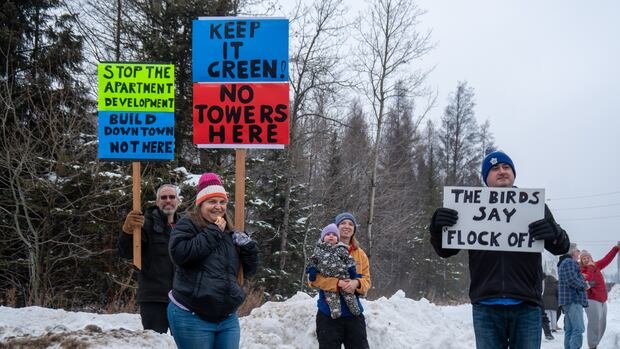
Charles Snell, a resident of Thunder Bay’s Red River ward, voiced his support for increased housing development in the area but raised concerns about sacrificing green spaces. Snell joined a group of around twenty individuals in protesting a proposed apartment complex that could potentially consist of 400 units between Junot Avenue and John Street. He emphasized the importance of considering alternative locations within the city, citing traffic congestion and excessive density as potential issues with the current proposal.
The property under discussion, situated at 300 Tokio St., is among the four vacant lands being evaluated by the city for potential sale to facilitate new residential projects. The other identified locations include 791 Arundel St., 144 Fanshaw St., and a mixed-use development at 211-213 Tupper St. and 224 Camelot St. These selections emerged from a competitive submission process, with the city shortlisting proposals that showcase innovation, quality, and a vision for a dynamic and thriving urban environment.
City council is set to vote on declaring the lands as surplus, enabling the proposed developments to progress through the necessary approval stages. Rod Seabrook, who orchestrated the recent protest, advocated for a focus on revitalizing downtown cores instead. Concerns raised by Seabrook and fellow residents revolved around the potential impact of the proposed housing units on traffic flow, sunlight access for adjacent properties, and the preservation of green spaces in the area.
Joel DePeuter, the city’s development services director, highlighted the pressing need for an additional 1,000 housing units to address the growing demand for accommodations in Thunder Bay. He stressed the importance of swift construction of larger multi-residential projects to meet this demand effectively. The city has already achieved its 2025 provincial housing target and secured substantial federal funding to expedite the creation of new housing units.
Should the surplus status be granted to the identified properties, the city will proceed with negotiating their sale and securing the required approvals for construction. DePeuter emphasized that the current proposals are preliminary and subject to modifications based on detailed assessments such as traffic and soil studies. Community members are encouraged to provide feedback on the proposals by reaching out to the development services department.
Councilor Michael Zussino, representing the Red River ward, acknowledged the community’s concerns while advocating for a balanced approach to development. He suggested incorporating conditions into the agreements to address stakeholder interests and find a mutually agreeable solution. Zussino supported the city’s emphasis on high-density housing to optimize existing resources and accommodate diverse housing needs effectively.
In navigating the evolving housing landscape, Zussino acknowledged the challenges of change but emphasized the potential benefits of adapting to new housing models to enhance neighborhood sustainability and address housing shortages effectively.