
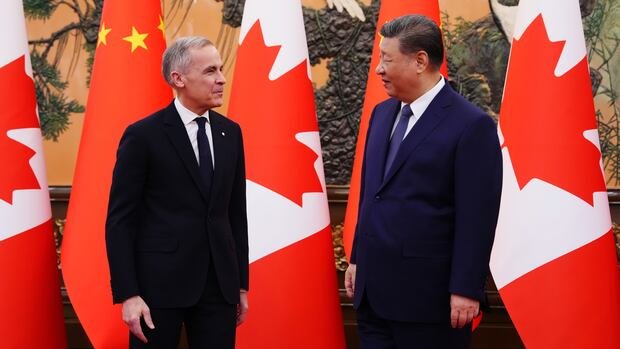
Donald Trump expressed approval of Prime Minister Mark Carney’s recent trade deal with China, deeming it a sensible move. Trump acknowledged the significance of forging a trade agreement with China and highlighted the importance of such deals. The negotiations leading to the deal were anticipated and discussions on its parameters had been ongoing for over a year.
The challenge for Carney was to strike a deal that would not alienate key stakeholders, such as the auto industry and Ontario Premier Doug Ford. With the impending review of the Canada-U.S.-Mexico Agreement (CUSMA), the Canadian delegation aimed to navigate the negotiations carefully to avoid displeasing the unpredictable U.S. president.
The trade deal permits the entry of 49,000 electric vehicles (EVs) into Canada initially, representing a small fraction of total vehicle sales. It also reduces Beijing’s tariffs on canola products, although they are not entirely eliminated. Market analysts suggest that the agreement does not violate any red lines set by the U.S. administration and is seen as a test by Carney to gauge boundaries.
While some American media outlets portrayed the deal as a divergence from the U.S., experts believe it should be viewed as a constructive reference point for Trump, rather than a contentious issue. Concerns raised by U.S. officials centered on the potential impact on American industries, emphasizing the need to safeguard domestic interests.
The deal is viewed as potentially problematic for Canada by some U.S. representatives due to the perceived risks of Chinese market penetration. Despite these reservations, U.S. officials do not foresee significant disruptions in Canada-U.S. trade relations arising from the agreement.
Analysts point out that Carney’s team skillfully avoided contentious issues that could provoke a U.S. backlash. Speculation suggests that the agreement may have received tacit approval from the U.S. administration through informal channels, leading to a relatively muted response from American officials initially.
As reactions unfold, there is anticipation regarding how the U.S. will perceive the deal and whether it could influence their own trade negotiations. Observers are curious to see if the U.S. may seek to mirror aspects of the Canada-China deal in their future trade discussions.