
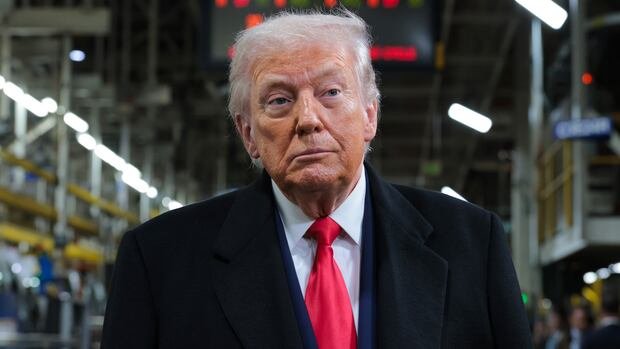
U.S. President Donald Trump remarked on Tuesday that the Canada-U.S.-Mexico Agreement, also known as CUSMA, holds little significance for the U.S., despite Canada’s interest. Trump emphasized the importance of bringing manufacturing operations back to American soil. The Detroit Three automakers heavily rely on supply chains that involve substantial parts production in Mexico and Canada, where they collectively manufacture hundreds of thousands of vehicles annually. Last year, major automakers urged the Trump administration to extend CUSMA, citing its critical role in American auto production.
The American Automotive Policy Council, representing the Detroit Three automakers, highlighted that CUSMA allows U.S.-based automakers to compete globally by leveraging regional integration for efficiency gains, resulting in significant annual cost savings. General Motors President Mark Reuss emphasized the complexity and strength of the interconnected supply chains across the three countries. Ford CEO Jim Farley echoed the sentiment, viewing Canada, Mexico, and the U.S. as an integrated manufacturing system.
During his visit to a Ford plant in Michigan, Trump expressed that the U.S. does not require cars manufactured in Canada or Mexico, emphasizing the preference for domestic production. Stellantis previously warned that under 15% tariffs with Japan, U.S. vehicles meeting North American content regulations could lose market share to Asian imports, affecting American automotive workers.
CUSMA is currently under review to determine its future, with Canada-U.S. Trade Minister Dominic LeBlanc initiating discussions with Mexican and U.S. counterparts. The focus remains on safeguarding the interests of Canadian workers and businesses during the review process. As negotiations unfold, Trump’s stance resonates with the initial posturing typical of such talks, according to Ontario’s trade representative in Washington, David Paterson.
The CUSMA trade pact, replacing NAFTA, mandates a joint review every six years. Trump’s characterization of the deal as “transitional” and discussions about potentially renegotiating separate agreements with Canada and Mexico have added uncertainty to the trade landscape. Observers suggest that Trump’s statements may prompt Canada to diversify its trade partnerships beyond the U.S. Prime Minister Mark Carney’s ongoing international trip aims to enhance trade and investment prospects, beginning in China and continuing to Qatar and Switzerland for the World Economic Forum.