
Francesca Nadin recently visited her friend Heba Muraisi in a British prison and was shocked by her drastic physical condition. Muraisi, a former florist and lifeguard, had been surviving solely on a mixture of water, salt, and vitamins since early November, a remarkable endurance of 73 days without solid food. Nadin expressed concern during their meeting, worrying that Muraisi was on the brink of death. However, on the 73rd day of their hunger strike, Muraisi, along with two other prisoners, Kamran Ahmed and Lewie Chiaramello, decided to end their protest against the treatment they received from Prime Minister Keir Starmer’s government and resume eating.
This act of endurance had not been seen in a U.K. prison since the 1981 hunger strike of Irish Republican Army prisoner Kieran Doherty. The hunger strikers’ supporters claimed victory following a report by The Times newspaper indicating that Elbit, an Israeli arms producer subsidiary, had lost a significant British defense contract worth over 2 billion pounds ($3.8 billion Cdn). Though there was no direct evidence linking the hunger strikers’ actions to the contract loss, activists still took credit for the outcome.
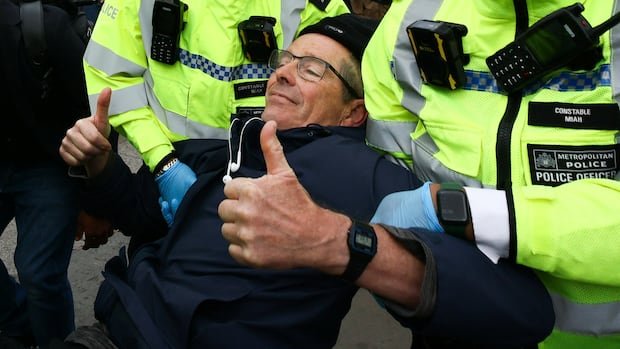
The hunger strike occurred amidst a contentious debate in the U.K. regarding the boundaries of opposition to Israel’s military actions in Gaza and its treatment of Palestinians. The British government categorized the protest group Palestine Action as a terrorist organization in a move considered unprecedented. The group’s actions, including vandalism against Israel-related companies, led to this designation, with Security Minister Dan Jarvis stating that their activities posed a significant threat.
As a result of the designation, over 2,400 individuals have been arrested by British authorities, with ongoing legal considerations to potentially overturn the decision. The hunger strikers, who had been incarcerated without trial for over a year, protested against the delay in their trials and their prison conditions. The hunger strike was also a demand for a meeting with government officials, which was refused.
The proscription of Palestine Action has sparked intense debate in the U.K., with human rights groups criticizing the government’s use of anti-terrorism legislation. Meanwhile, supporters of Israel advocate for a tougher stance against the protesters. The polarization extends to public opinion, with surveys revealing mixed sentiments regarding the group’s proscription and broader support for Palestinian causes.
Pro-Israel advocates in the U.K. Parliament, including figures like Lord Walney, have urged the government to maintain pressure on Palestine Action. Lord Walney, a former Independent Adviser on Political Violence, lauded the proscription’s effectiveness in curbing attacks. However, he acknowledged the need to reassess what constitutes terrorist activities, proposing enhanced police powers to target specific aspects of proscribed group activities.
Demonstrations against Israel’s actions in Gaza and the occupation of Palestinian territories have mobilized large anti-war movements in the U.K. since 2023. The recent protests have drawn significant public participation, reflecting deep societal divisions on the issue. The hunger strikers’ actions have resonated widely, generating solidarity and highlighting government responses to dissent.
The focus now shifts to the judicial review of the decision to proscribe Palestine Action, a pivotal moment with implications for human rights and future protests. Meanwhile, Heba Muraisi and her fellow hunger strikers are undergoing refeeding in a prison infirmary following the end of their protest. Muraisi remains positive about the impact of their hunger strike and achievements.