
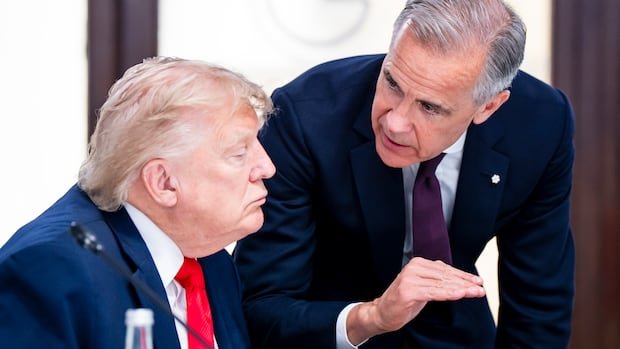
U.S. Trade Representative Jamieson Greer may prefer not to label it a trade “war,” but regardless of the terminology used — a disagreement? a discrepancy? a standoff? — the conflict has persisted for over 19 months.
In February 2025, Donald Trump, going against a free trade agreement he previously endorsed in 2018, initially imposed tariffs on various Canadian goods.
It appears that it could be several additional months before tensions de-escalate, let alone come to a resolution.
Wolfgang Alschner, a business and trade law professor at the University of Ottawa, mentioned, “It is more probable than not that the current state of affairs will remain unaltered until year-end.” He indicated that while there is a potential compromise on the table from recent discussions, the negotiating parties are currently too far apart to easily reach an agreement. The existing situation is challenging, but not dire enough to push either side to alter their stance.
Mark Carney, speaking to journalists, characterized the recent round of American tariffs announced as “relatively modest,” especially when compared to other actions taken by the U.S. administration. This stance may suggest a reluctance to retaliate further against American imports, hinting at a possible equilibrium in the recent escalation cycle.
Canada expresses readiness to negotiate a fair deal, yet both sides appear entrenched in their positions. The key negotiators, including Greer from the U.S. and Dominic LeBlanc and Janice Charette representing the Canadian government, have maintained professionalism and avoided political entanglements, possibly leaving room for future negotiations.
Meredith Lilly, an international economic policy professor at Carleton University and a former trade adviser, highlighted potential “trigger moments” that could reignite talks in the coming months. Developments such as a resolution between the United States and Mexico or the outcome of the U.S. midterm elections could impact the negotiation landscape. Additionally, there looms a threat of new auto and truck tariffs from the U.S. starting January 1, 2027.
While some believe in the U.S.’s economic advantage, others argue that Canada holds the political edge, with strong public support against the perceived threat. The political resolve and unity among Canadians in the face of the trade dispute are noted as crucial factors.
The public sentiment in Canada could pose challenges to reaching a new deal, as observed by experts and analysts. The ongoing trade conflict is not only testing economic strength but also political determination on both sides.
As negotiations face uncertainties, the role of public opinion and political leadership becomes increasingly significant in determining the path forward. The impact of the prolonged trade dispute on U.S.-Canada relations and public perceptions remains a subject of concern and speculation.