
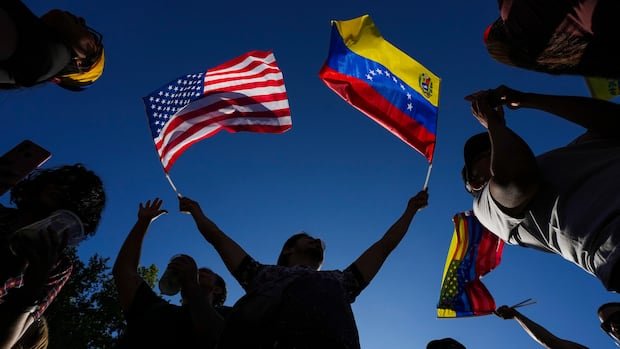
Just hours following the announcement of the United States’ military action in oil-rich Venezuela and the apprehension of President Nicolás Maduro, Katie Miller, the wife of a key adviser to U.S. President Donald Trump, posted a strong caution to Canada on social media. Miller stated that the U.S. no longer requires anything from Canada and declared the end of free trade between the two countries.
This sentiment, echoing previous statements from Trump and his close circle, has gained significance with the potential access to Venezuela’s substantial reserves of heavy crude oil similar to that found in Western Canada. As Canada prepares for the review of the Canada-U.S.-Mexico Agreement (CUSMA), experts and former officials are deliberating on how the developments in Venezuela may impact Canada’s negotiating position.
According to RJ Johnston, the director of energy and natural resources policy at the University of Calgary, Venezuela’s oil industry and infrastructure have been in decline for over a decade, posing risks for U.S. oil companies contemplating re-entry into the country. Johnston highlighted that significant government support and investment would be required to entice U.S. firms to engage in large-scale projects in Venezuela.
The U.S. government is pushing oil executives to swiftly return to Venezuela, emphasizing the need for substantial capital investment to revitalize the country’s oil sector. In response, Prime Minister Mark Carney expressed confidence in Canada’s oil competitiveness, citing lower costs, environmentally friendly production, and reduced risk compared to Venezuela.
Despite the recent U.S. intervention in Venezuela, former officials like Kate Kalutkiewicz and Fen Osler Hampson believe that the event does not immediately impact trade negotiations between Canada and the U.S. However, it underscores Trump’s strategy to diversify trading partners and create negotiation leverage. Hampson emphasized the U.S.’s focus on securing critical resources in the region, potentially reshaping Canada’s role in North American trade.
Looking beyond the oil sector, the U.S. has outlined demands for Canada in the CUSMA renegotiation, including market access for dairy products, addressing alcohol boycotts, and revising online streaming regulations. Laura Dawson of the Future Borders Coalition cautioned that concessions in trade talks have real economic consequences and must be approached cautiously.
While the future of CUSMA remains uncertain, experts like Kalutkiewicz remain optimistic about the enduring strength of the North American economic relationship, underscoring the importance of the regional supply chain for U.S. economic competitiveness.