
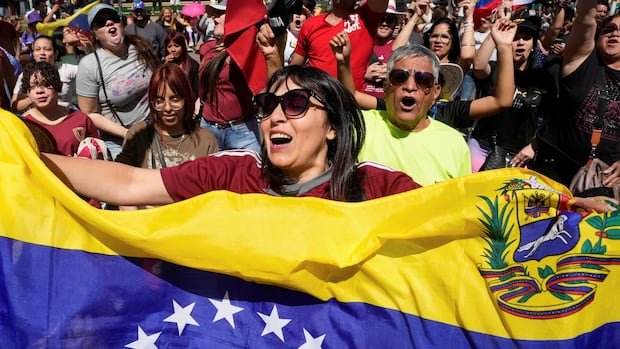
Venezuelan migrants worldwide erupted in jubilation on Saturday following the U.S.-led apprehension of President Nicolas Maduro, whose administration oversaw one of the largest migration waves in recent history. Cheers celebrating Maduro’s capture resonated through the streets of Chile’s capital, where Venezuelan expatriates gathered to express their happiness.
“We are liberated. We are all thrilled that the dictatorship has collapsed, and we now have a free nation,” stated Khaty Yanez, a Venezuelan woman residing in Chile for seven years. “My happiness knows no bounds,” echoed her compatriot Jose Gregorio. “After numerous years of struggle and hard work, today marks a significant day. Today is the day of liberation.”
Since 2014, an estimated 7.7 million Venezuelans, constituting 20% of the population, have left the country due to economic hardships or in pursuit of better prospects abroad, as reported by the U.N. International Organization for Migration. Colombia has welcomed the largest number of migrants, approximately 2.8 million, followed by Peru with 1.7 million Venezuelan arrivals, according to the R4V platform established by the U.N. migration agency to aid migrants and refugees from Venezuela.
In Lima, Peru’s capital, numerous Venezuelans draped in their national flag congregated to commemorate Maduro’s capture. Venezuelan migrant Milagros Ortega, whose parents remain in Venezuela, expressed her desire to return home, particularly moved by the thought of her father witnessing Maduro’s downfall.
Peruvian President Jose Jeri announced plans to facilitate the immediate return of Venezuelans, irrespective of their immigration status. While the U.S. previously served as a sanctuary for many Venezuelans, a significant shift occurred during President Donald Trump’s second term, prompting individuals to seek refuge elsewhere due to unfavorable circumstances.
In Spain, a multitude gathered at central Madrid’s Puerta del Sol, applauding as they watched Trump’s live press conference. Similarly, groups of Venezuelans are anticipated to gather in Argentina’s capital, Buenos Aires, to celebrate later in the day.
Following the initial elation, concerns about Venezuela’s future began to surface among Venezuelans abroad, pondering what lies ahead for their nation and its citizens. Andres Losada, residing in Spain for three years among the 400,000 Venezuelan expatriates in the country, expressed a mix of anxiety and joy regarding the Venezuelan situation.
Amidst speculations about Venezuela’s future, Venezuelan security forces patrolled the relatively deserted streets of Caracas, the capital, on Saturday. While most residents stayed indoors, absorbing the latest updates on their devices, some ventured out to stock up on essentials in preparation for potential prolonged seclusion.
Speaking to a local TV station in Spain, Agustin Rodriguez, vice president of a Venezuelan cultural association, voiced concerns about the strikes but acknowledged their potential necessity to pave the way for a return to power alternation and a brighter future for the country.