
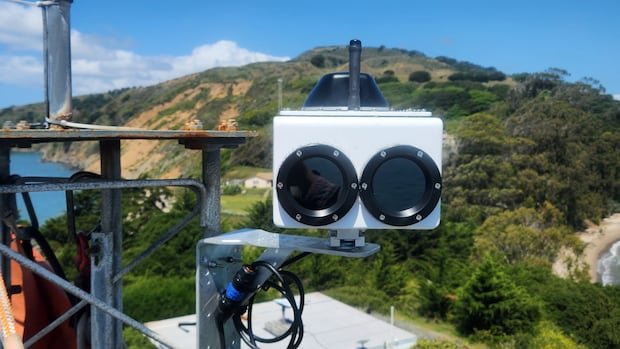
Marine scientists in British Columbia believe that adopting a similar collaborative strategy for whale monitoring as seen in parts of California could help mitigate the risk of whale strikes in the region. In San Francisco Bay, a joint effort involving scientists, ferry operators, and the public is underway to track whale movements using specialized cameras and an app.
These WhaleSpotter cameras, enclosed in compact white boxes similar to microwaves, utilize thermal imaging technology to observe whale activities around the clock. The data collected from these cameras is integrated with human sightings on a publicly accessible app. Daniel Zitterbart, the lead scientist at WhaleSpotter, emphasized the importance of having more eyes on the water to enhance whale protection.
While some WhaleSpotter cameras are already operational in British Columbia, they are currently land-based and lack the coverage of ferry-mounted cameras, limiting their whale detection range to approximately two nautical miles. Monitoring marine mammals is crucial for understanding their migratory paths and reducing vessel collisions, an issue that has gained significant attention in B.C. due to several documented whale strikes in recent years.
In San Francisco Bay, the WhaleSpotter cameras are linked to the Whale Safe app, enabling scientists, mariners, researchers, and the public to track whale sightings collaboratively. Douglas McCauley, the director of the Benioff Ocean Science Laboratory, highlighted the community-driven nature of this initiative as a valuable resource for all stakeholders.
In British Columbia, only authorized commercial mariners have access to the camera data through the Ocean Wise whale report alert system, restricting public visibility. Thomas Hall from San Francisco Bay Ferry expressed optimism about using ferry-mounted cameras to monitor whale behavior and patterns over time. Zitterbart advocated for the expanded use of similar cameras on B.C. Ferries routes to safeguard whales.
Efforts to enhance collaborative conservation measures have intensified as ship traffic rises, and climate change alters whale behaviors. Researchers in San Francisco Bay have observed increased grey whale presence, possibly due to their search for new food sources during their northward migration. The Benioff Ocean Science Laboratory reported 21 whale deaths in the bay last year, with 40% showing signs of ship strikes.
Conservation biologist Sean Brillant from the Canadian Wildlife Federation emphasized the urgency of addressing vessel strikes as a significant threat to whales in Canada. He stressed the need for cross-border cooperation and data sharing to protect whales effectively, emphasizing the global nature of the issue.