
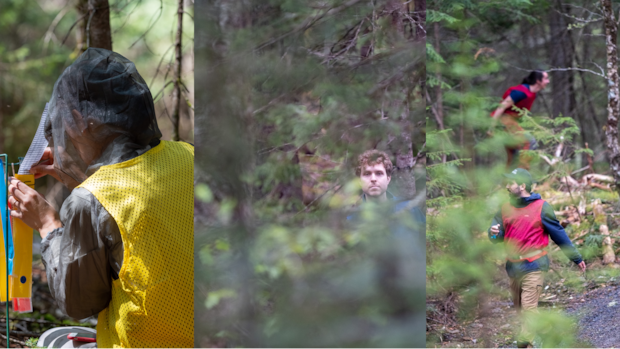
Skulking cautiously through Quebec’s forests, feeling the adrenaline rush while competing for limited resources and evading predators is all part of a typical day for ecologist David Bolduc from Université Laval.
To delve deeper into the intricate dynamics between predators and prey in nature, Bolduc, along with colleagues and a group of international students, convened at the Éco-Laurentides park near Val-Morin, Que., for a predator-prey simulation game.
“The rules are straightforward,” explained Bolduc to As It Happens host Nil Köksal. “You either survive or perish.”
During the experiment in July 2023, participants were divided into prey, mesopredators, and apex predators groups. The prey’s objective was to gather resources, reproduce by teaming up with their peers, and avoid being captured by predators.
On the other hand, the predators’ task was to hunt down the prey. Winning meant surviving by securing enough food and avoiding being caught, as elucidated by Bolduc.
The study, documented in the open-access journal Methods in Ecology and Evolution, revealed that humans often employ similar survival tactics as animals like wolves or deer. While hailed as a fun and innovative approach to studying ecosystems, scientists cautioned that the game’s findings may not directly translate to real-life animal behaviors where survival is a matter of life and death.
The researchers viewed the game as a practical method to explore predator-prey interactions, offering a more realistic alternative to controlled mathematical models and fieldwork challenges in witnessing predation and managing multiple variables.
Although the game provides valuable insights, the researchers emphasized the necessity of complementing the findings with observations of actual animals in their natural habitats.
Impressed by the experiment, scientists not involved in the study commended the innovative approach as a valuable tool for understanding animal behaviors and ecological dynamics.
The study highlighted similarities in human behavior during the game compared to wildlife. However, experts cautioned that inherent human biases, competitiveness, and the absence of real-life risks differentiate human gameplay from actual predator-prey interactions in nature.
Despite these distinctions, the researchers emphasized the game’s educational value, fostering engaging discussions on ecological theory and animal behavior among players.
In conclusion, the predator-prey simulation game proved to be a stimulating and informative method for exploring ecological concepts and fostering learning experiences.