
Oil prices experienced a decline on Wednesday, while global stock markets saw a rally amid growing optimism regarding a potential agreement between the United States and Iran. This agreement could lead to the resumption of crude oil shipments from the Persian Gulf to customers. The price of Brent crude oil, the international benchmark, dropped by 7.8% to slightly above $100 per barrel, down from over $115 earlier in the week.
President Donald Trump’s social media statement hinted at the opening of the Strait of Hormuz for all if Iran agrees to an undisclosed reported deal. The blockade of this crucial strait due to tensions with Iran has disrupted global oil trade, causing inflationary pressures on various products worldwide. A potential reopening of the strait could ease these pressures.
In response to these developments, Wall Street witnessed significant gains, with the S&P 500 surging by 1.5% and reaching a new all-time high. The Dow Jones Industrial Average rose by 612 points, or 1.2%, while the Nasdaq composite set its own record by climbing 2%. In Canada, the S&P/TSX composite index closed up around 1.2% at 33,981.82.
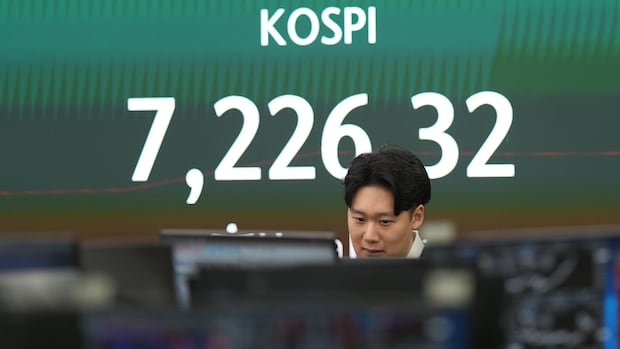
International markets also experienced substantial increases, with Seoul’s index surging by 6.5%, Paris by 2.9%, and London by 2.1%.
Although there have been previous instances of optimism regarding a potential resolution to the Iran conflict, which were short-lived, the current situation remains uncertain. Despite initial steep declines in oil prices, they partially recovered after briefly dipping below $97 per barrel. President Trump’s threats of heightened military action in the absence of an agreement with Iran added to the volatility.
On a positive note, Trump indicated a temporary halt to forcibly reopening the Strait of Hormuz. Additionally, China’s call for a comprehensive ceasefire following talks with Iran could play a significant role given their close economic and political ties.
Amidst these geopolitical uncertainties, major U.S. companies continue to report better-than-expected profits, contributing to the market’s resilience. Chip company AMD, in particular, saw a notable surge of 18.6% after surpassing profit and revenue expectations. Other companies in the AI sector, such as Super Micro Computer and Nvidia, also performed well.
Companies reliant on fuel costs benefitted from hopes of further oil price reductions, with airlines and cruise companies experiencing notable gains. In the bond market, Treasury yields decreased as oil price declines alleviated inflation concerns, with the 10-year U.S. Treasury yield dropping to 4.35%.
Overall, the markets remain sensitive to geopolitical developments, corporate earnings, and oil price fluctuations as investors navigate through uncertain times.