
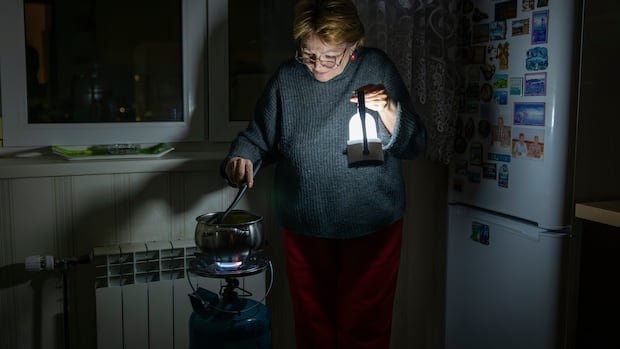
Olena Janchuk is enduring another day of cold solitude in her high-rise apartment.
A former kindergarten teacher, Janchuk suffers from severe rheumatoid arthritis and has been confined to the 19th floor of her Kyiv tower block for weeks, a daunting 650 steps above ground level.
Frequent power outages caused by Russia’s attacks on power facilities have rendered functioning elevators scarce luxuries.
Amidst sub-zero temperatures in January, frost constantly lines Janchuk’s windows, intricate white patterns creeping across the glass by daybreak.
The 53-year-old huddles near a makeshift fireplace made of candles positioned under stacked bricks, serving to absorb and gradually emit warmth. USB charging cables sprawl across the floor from overloaded power strips, while her electric blanket is connected to a power bank rationed for the coldest times.
“When there’s no light or heat for 17 and a half hours, you have to improvise,” she remarked. “The bricks work best in a small space, so we huddle there.”
During daylight hours, the family relocates to rooms that capture the winter sun, with each space’s purpose adjusting to the blackout timetable. At night, they remain bundled up indoors as the apartment rapidly cools without central heating.
Kyiv, home to approximately three million residents, is characterized by tower blocks, many remnants from the Soviet era, now deprived of power for most of the day.
In this fourth winter of conflict, electricity is a scarce commodity.
Residents meticulously schedule their activities around the availability of electricity: determining when to cook, shower, charge devices, and do laundry. Food choices prioritize shelf life, water is filtered into containers and stored in buckets, and small camping stoves are utilized to heat soup or tea during power outages.
Sleep is interrupted by air raid sirens and the necessity to utilize electricity during designated off-peak periods.
Outside, amidst snow-covered Kyiv, diesel generators hum along commercial streets. Shoppers navigate aisles using phone lights, and candlelit bars illuminate the night.
Applications alert users to shrinking electricity timeframes—often just a few hours—sufficient for basic household operations.

Challenges Mount on Higher Floors
Janchuk’s 22-story building, positioned near a power station, provides inhabitants with a front-row view of missile and drone strikes, with flashes illuminating the night sky.
During blackouts, residents ascend the darkened stairwells, their phone lights casting shadows on concrete steps, often accompanied by the sounds of children and barking dogs. Some individuals leave parcels containing cookies or water inside elevators for those stranded when power cuts out mid-ride.
While Janchuk’s husband spends most of the day at work, he returns in the evening with groceries, as her 72-year-old mother, Lyudmila Bachurina, manages household tasks.
- <