
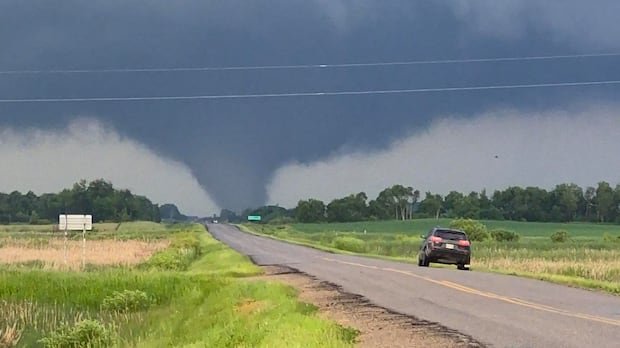
Federal budget cuts to a weather radar research team could impede meteorologists’ ability to detect approaching tornadoes, as highlighted by a University of Manitoba atmospheric science professor following a recent tornado strike in a Winnipeg neighborhood without prior warning. Despite a previous government investment of $180 million to deploy 33 advanced weather radar systems nationwide a decade ago, concerns persist due to outdated software and algorithms utilized by forecasters to analyze radar data.
The discontinuation of the specialized research team, as noted by Professor John Hanesiak, may hinder necessary enhancements to the software and algorithms required for interpreting radar information effectively. In efforts to address this issue, Hanesiak and a group of eight weather researchers penned a letter to Environment and Climate Change Minister Julie Dabrusin, emphasizing the significance of the disassembled weather radar research unit under Environment and Climate Change Canada.
The primary aim of the disbanded team was to optimize the national weather radar network’s functionality to potentially mitigate fatalities, injuries, and property damage resulting from severe weather events. Responding to concerns, Minister Dabrusin assured that despite cost-cutting measures, the government remains committed to sustaining the operational radar network with necessary scientific and technical support.
In the aftermath of a tornado striking the Whyte Ridge area of Winnipeg, local city councillor Janice Lukes underlined the vital role of timely alerts provided by radar systems. Residents expressed dismay over the absence of advance warnings, particularly given previous tornado warnings in the region earlier in the month.
While Environment Canada pointed out the issuance of severe thunderstorm alerts prior to the tornado event, concerns persist regarding the effectiveness of current radar technology in predicting such phenomena accurately. Professor Hanesiak stressed the urgency of upgrading software and algorithms to optimize the performance of the newly installed weather radar systems across Canada.
In conclusion, the importance of modernizing forecasting tools and technologies to enhance early warning capabilities and improve public safety during severe weather events is paramount. Efforts to address deficiencies in radar interpretation methods are crucial for empowering meteorologists to provide accurate and timely alerts to vulnerable communities.