
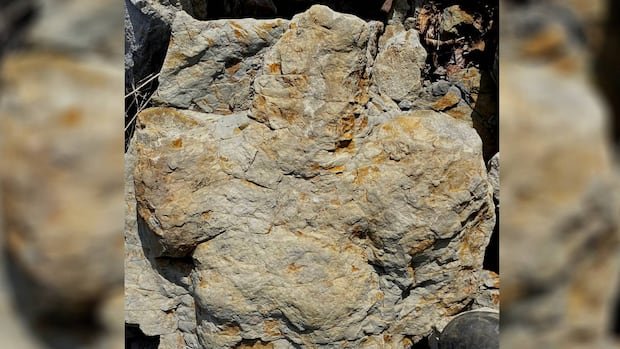
In 1988, Guy Plint, an earth scientist, was studying sedimentary formations in Tumbler Ridge, British Columbia. During his research on 86-million-year-old formations, he accidentally discovered tracks made by duck-billed dinosaurs. Today, the region in northeast B.C. is recognized as a UNESCO Global Geopark renowned for its vast collection of prehistoric fossils. Collaborating with a local paleontologist, Plint is delving into the history of these tracks. According to Plint, these tracks are the northernmost of their kind in North America, with similar tracks found in southern Montana based on his extensive literature review.
Recently, Plint and Dr. Charles Helm, a local physician and paleontologist, co-authored a research paper unveiling new findings about the tracks. They determined that the fossilized footprints date back to the Coniacian age, a period in the Late Cretaceous era approximately 85 to 89 million years ago. The research indicates a transition in dinosaur species following the introduction of flowering plants as a dietary source. Ankylosaurs, armored dinosaurs, had dominated as herbivores before the Coniacian period. However, duck-billed dinosaurs had replaced them as the most prevalent plant-eaters.
The area where the tracks were discovered was once a prehistoric delta adjacent to an inland sea. This geographical setting, which Plint was studying in 1988, has preserved terrestrial sediments that offer valuable insights into past ecosystems. Plint highlighted that these Coniacian age dinosaur tracks are the only ones known in Canada, emphasizing the significance of the Tumbler Ridge site in preserving such ancient remnants.
In their recent research, Plint and Helm explored five sites in 2022, 2023, and 2025, recovering and curating five individual tracks now part of the Tumbler Ridge Museum’s collection. These tracks provide a rare glimpse into a thriving dinosaur community that existed in the region millions of years ago. Eamon Drysdale, the museum’s resident paleontologist and curator, mentioned the importance of these tracks in understanding the evolutionary changes in dinosaur species during the Cretaceous period.
The museum has taken measures to safeguard the tracks found by Plint and Helm to prevent any damage. Drysdale noted the scarcity of body fossil records during the transition period between different dinosaur species, making these tracks crucial for comprehending the evolutionary dynamics of dinosaurs at that time.