
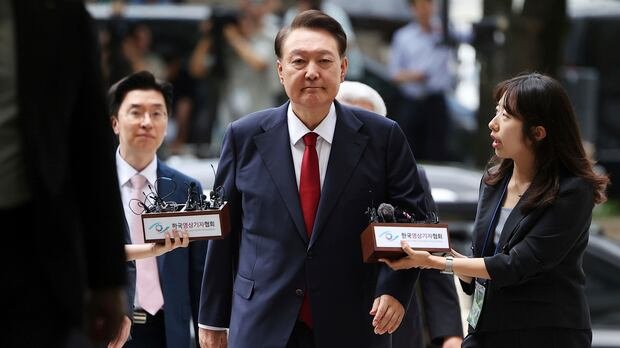
Former South Korean President Yoon Suk Yeol has been sentenced to five years in prison by a South Korean court for his involvement in obstructing authorities from arresting him after his failed attempt to enforce martial law in December 2024. The Seoul Central District Court found Yoon guilty of utilizing the presidential security service to impede the execution of an arrest warrant issued by the court to investigate his martial law declaration. Yoon was also convicted of creating fake official documents and disregarding legal procedures pertaining to martial law.
This ruling marks the initial decision in the criminal charges Yoon is facing regarding his unsuccessful martial law declaration. The lead judge emphasized that Yoon misused his presidential influence to hinder the execution of lawful warrants by using officials from the Security Service for personal safety and gain.
Following the court’s verdict, one of Yoon’s attorneys, Yoo Jung-hwa, announced that the former president intends to appeal the ruling, expressing disappointment over what she described as a politicized decision. Yoon is also facing a separate trial where he could potentially receive the death penalty for orchestrating an insurrection through his unjustified declaration of martial law.
Yoon has maintained that his declaration of martial law was a legitimate exercise of his presidential authority intended to address government obstruction by opposition parties. Despite denying the charges brought against him, Yoon faced the possibility of a decade in prison for the obstruction offenses related to his actions during the investigation when he barricaded himself in his residence and instructed the security service to impede the authorities.
Yoon’s arrest, which involved a significant law enforcement operation with over 3,000 police officers, marked the first time a sitting South Korean president had been detained. Subsequently, the parliament swiftly moved to annul his martial law decree and impeach him, leading to the suspension of his presidential powers. In April of the following year, he was officially removed from office by the Constitutional Court for breaching his official duties.
Although Yoon’s attempt to impose martial law was short-lived, lasting around six hours, it caused significant upheaval in South Korea, a country known for its robust democracy and strong economic ties as a key U.S. ally in the region.