
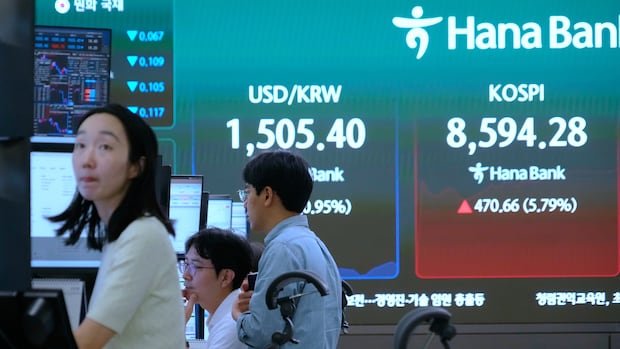
Global stock markets experienced a surge on Monday, while oil prices saw a decline following the announcement of a tentative agreement between the United States and Iran to extend their ceasefire and reopen the Strait of Hormuz, aiming to restore the global flow of crude oil.
The S&P 500 saw a 1.7% increase, reflecting optimism about a potential long-term resolution to the conflict that had previously led to a surge in prices worldwide. The Dow Jones Industrial Average rose by 0.9%, and the Nasdaq composite surged by 3.1%. In Canada, the TSX/S&P composite index also climbed approximately 1% by the end of the day.
The price of Brent crude oil, the international benchmark, dropped by 4.8% to $83.17 US per barrel, returning to levels seen in early March. Although still higher than pre-war prices of around $70, it is a decrease from the recent $100+ range. This drop in oil prices is expected to alleviate financial pressure on households and businesses, which had been grappling with increased costs due to supply disruptions caused by the conflict with Iran.
While Iran confirmed the tentative agreement, implementation is pending a signing scheduled for Friday in Switzerland. Ongoing negotiations, particularly concerning Iran’s nuclear program, are anticipated to continue over the next 60 days. The reopening of the Strait of Hormuz, if realized, may take several months for the energy industry to fully recover.
Despite the positive market response, concerns linger about potential setbacks to the agreement, as seen in previous failed attempts at peace deals between the U.S. and Iran. Analysts caution that any breakdown in the agreement could lead to a swift reversal in oil markets.
The easing of tensions in the Middle East and the decline in oil prices also impacted various sectors. Companies heavily reliant on fuel, such as United Airlines and Royal Caribbean Group, saw stock gains. Additionally, stocks related to artificial intelligence (AI) experienced notable increases, with SpaceX, owned by Elon Musk and including the AI company xAI, rising by 19.6% on its second day of trading on Wall Street.
In the bond market, treasury yields decreased, driven by expectations that lower oil prices could alleviate pressure on central banks to raise interest rates globally. Stock markets in Asia and Europe also saw positive movements, with Japan’s Nikkei 225 and South Korea’s Kospi posting significant gains. However, London’s FTSE 100 experienced a marginal decrease of 0.4%.
The market outlook remains optimistic, with hopes that the agreement between the U.S. and Iran will lead to sustained stability and support continued economic recovery.
This news provides a comprehensive overview of the recent developments in global stock markets and the oil industry, highlighting the potential impacts of the U.S.-Iran agreement on market dynamics and investor sentiment.