
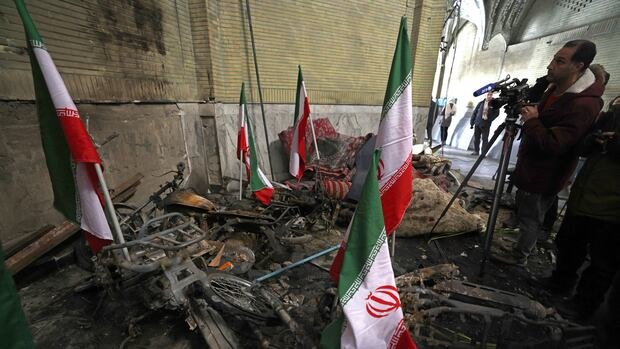
Iran’s chief prosecutor refuted President Donald Trump’s assertions that he prevented the hanging of 800 detained protestors in the country as “entirely untrue.” At the same time, the death toll resulting from a violent crackdown on nationwide protests has climbed to a minimum of 5,032, according to activists.
Amid concerns that more casualties have occurred, activists face challenges in verifying details due to an extensive internet blackout in Iran, now surpassing two weeks. As tensions persist between the United States and Iran, an American aircraft carrier group moves closer to the Middle East—a move Trump likened to an “armada” in recent remarks to journalists.
Experts suggest that the military buildup could provide Trump with the option to launch strikes, despite his avoidance of such actions despite repeated warnings to Tehran. The potential mass execution of prisoners had been a red line for military intervention for Trump, along with the killing of peaceful protestors.
In a statement on Friday, the Soufan Center, a New York-based think tank, noted, “While President Trump appears to have reversed his stance, possibly due to pressure from regional leaders and recognition that airstrikes alone may not destabilize the regime, military assets are still being deployed to the region, hinting at the possibility of kinetic action.”
In response to Trump’s claims that Iran halted the execution of 800 detainees during the protests, Mohammad Movahedi, Iran’s chief prosecutor, categorically denied the assertion as baseless. Judiciary officials have labeled some detainees as “mohareb,” meaning “enemies of God,” a charge punishable by death. This charge was employed in mass executions in 1988, resulting in the reported deaths of at least 5,000 individuals.
During a special session at the UN Human Rights Council in Geneva, Volker Türk, the UN high commissioner for human rights, expressed alarm over conflicting statements from Iranian authorities regarding the possible execution of protest-related detainees. Türk highlighted Iran’s status as one of the leading countries in executions, with reports indicating a 50% increase in executions in 2024 compared to the previous year.
Furthermore, Mohammad Javad Haji Ali Akbari, the Friday prayer leader in Tehran, derided Trump as a “yellow-faced, yellow-haired and disgraced man,” likening him to a barking dog. The cleric warned that any harm caused would result in Iranian forces targeting U.S. interests and installations in the region.
The latest death toll figures, provided by the U.S.-based Human Rights Activists News Agency (HRANA), indicate that 4,716 of the deceased were protestors, 203 were linked to the government, 43 were minors, and 40 were civilians uninvolved in the demonstrations. Additionally, over 27,600 individuals have been detained in a widespread campaign by authorities.
The accuracy of HRANA’s figures in past Iranian unrest underscores the severity of the current situation, surpassing previous protest-related casualties in the country and evoking memories of the turmoil surrounding the 1979 Islamic Revolution. Iran’s government recently disclosed a death toll of 3,117 individuals, comprising civilians, security personnel, and alleged “terrorists” in the protests that began on December 28.
The U.S. military has bolstered its presence in the Middle East, deploying the aircraft carrier USS Abraham Lincoln and accompanying warships from the South China Sea. Trump indicated that the ships were being positioned towards Iran as a precautionary measure, emphasizing the potential for military action but expressing hope that it might not be necessary.
Trump referenced prior discussions between American officials and Iran concerning its nuclear program, preceding Israel’s military action against Iran in June. He warned of retaliatory military measures, surpassing previous attacks on Iranian nuclear facilities, urging Iran to engage in negotiations to avoid conflict.
Iran’s Foreign Ministry, led by Abbas Araghchi, has engaged in talks with U.S. envoy Steve Witkoff over Iran’s nuclear program, maintaining a channel for diplomatic dialogue.