
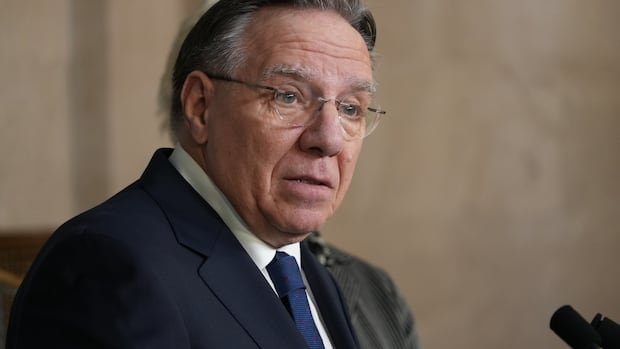
Quebec Premier François Legault has declared his resignation, marking the end of his significant tenure in provincial politics where he led the party he established to two majority governments. Legault stated that he will continue in his role until his party selects a new leader, announcing this decision at a press conference on Wednesday morning.
Recognizing the desire for change among many Quebecers, Legault, accompanied by his wife and top aide, acknowledged the need for a new premier. The resignation follows a period of unrest, declining poll numbers, and the departure of ministers from the party. Despite acknowledging some shortcomings, Legault emphasized the successes achieved during his time in office.
The Coalition Avenir Québec (CAQ) has a limited time to appoint a new leader before the election scheduled for October 5, 2026. Legault has been serving as Quebec’s premier since 2018 and has led the CAQ since 2011.
In recent months, several key figures, including social services minister Lionel Carmant and health minister Christian Dubé, parted ways with the CAQ due to disagreements over government policies. Additionally, various Members of the National Assembly (MNAs) either left or were expelled from the party, with some seeking affiliation with other political groups.
A recent Pallas Data poll revealed that the premier and his party have a mere 10% voter intention rate, with over 50% of respondents expressing a “very unfavorable” opinion of Legault. Meanwhile, the Parti Québécois (PQ), which has pledged a referendum if victorious, has been leading in polls, gaining three seats from the CAQ in consecutive by-elections since 2023.
Various politicians, including Prime Minister Mark Carney, PQ Leader Paul St-Pierre Plamondon, and Interim Liberal Leader Marc Tanguay, shared their reactions to Legault’s resignation, acknowledging his contributions and years of public service. Despite differing political views, they commended Legault’s dedication to Quebec.
While some praised Legault for his accomplishments, such as revitalizing Quebec’s economy and energy sector, others criticized his legacy. Unions expressed concerns about the state of the public health system under his leadership, and Indigenous leaders welcomed his departure after years of government denial regarding systemic racism in Quebec.
Before entering politics, Legault co-founded Air Transat and served as a Member of the National Assembly (MNA) from 1998 to 2009. His nationalist party, the CAQ, reshaped Quebec’s political landscape by offering an alternative to the independence debate, marking the first party since 1970 to win against the Liberals or PQ.
Despite his achievements, controversy surrounded Legault’s energy policies, notably the financial loss incurred from the Northvolt battery plant bankruptcy. His government’s emphasis on identity politics, including secularism measures and language protection laws, defined his tenure.
Reflecting on his time as premier, Legault highlighted his government’s response to the COVID-19 pandemic and thanked Quebecers for their sacrifices. Expressing gratitude for the opportunity to serve, he concluded his remarks, emphasizing his love for the people of Quebec.