
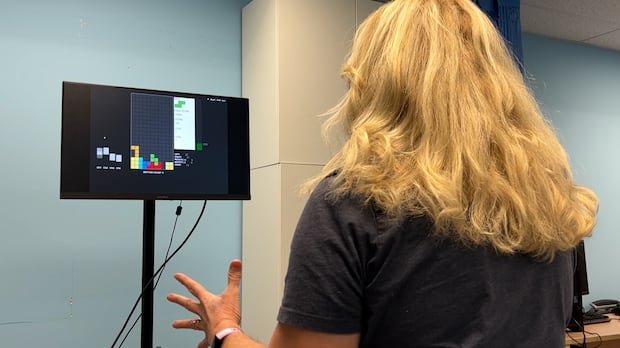
Diane Bouwman, who received a multiple sclerosis diagnosis in 2001, shared that the illness can significantly impact one’s self-assurance. Recounting her experience to CBC Hamilton, she mentioned the numerous falls she had endured, emphasizing that losing confidence was a major consequence of these incidents. However, a McMaster University research initiative involving the classic video game Tetris proved instrumental in helping her regain her confidence.
Multiple sclerosis, commonly known as MS, is a neurological disorder affecting the central nervous system. The condition leads to the immune system attacking myelin, a protective sheath covering the nerves. Typical symptoms of MS include fatigue, impaired balance, muscle weakness, tingling sensations, vision disturbances, and mood changes. MS is a chronic condition without a known cure and can progress through various stages over time.
Bouwman participated in the research program starting in February 2024. For six weeks, she commuted from her residence in Kitchener, Ont., to Hamilton three times a week, where she connected her body to a computer and engaged in playing Tetris. The study, conceptualized by Stephen Toepp, a PhD candidate in McMaster’s kinesiology department, aimed to offer an accessible alternative to conventional exercise methods like weightlifting. Participants were tasked with performing specific movements linked to Tetris inputs, tailored to target areas for improvement.
While the primary focus was not on playing the game itself but on creating challenging physical scenarios, McMaster’s Neuro Lab continues seeking additional participants diagnosed with MS to further advance the study. Those interested can find more information on participation by visiting the lab’s website and contacting Toepp.
Statistics reveal that women are up to three times more likely to be diagnosed with MS compared to men. Aimee Nelson, a professor at McMaster University specializing in kinesiology and biomedical engineering, highlighted the study’s significance in addressing research gaps concerning women’s health. The research initially aimed to enhance upper limb control for activities like eating but shifted focus based on feedback from MS patients who prioritized regaining balance and reducing fall risks.
The study employs EMG biofeedback, a system using muscle activity to manipulate a cursor on a computer screen. Initial feedback suggests that participants are finding the EMG biofeedback engaging and beneficial, with preliminary data indicating positive outcomes. However, Nelson emphasized the need for further analysis to establish statistically significant findings.
Bouwman expressed her competitive spirit and deep engagement in the Tetris workouts, noting how they allowed her to maintain energy for activities like lunch outings with her husband, unlike traditional training that left her fatigued. Toepp’s choice of Tetris stemmed from its simplicity and widespread popularity, enabling the method to captivate participants effectively.
Reflecting on her journey, Bouwman acknowledged the program’s transformative impact, helping her overcome initial insecurities related to balance issues. Despite experiencing post-session discomfort, she deemed the program worthwhile, as it boosted her confidence in physical movements and provided a sense of stability and progress. Bouwman’s resilience shone through as she shared her perspective on navigating the challenges posed by MS, emphasizing the importance of celebrating small victories and maintaining a positive outlook on her journey.