
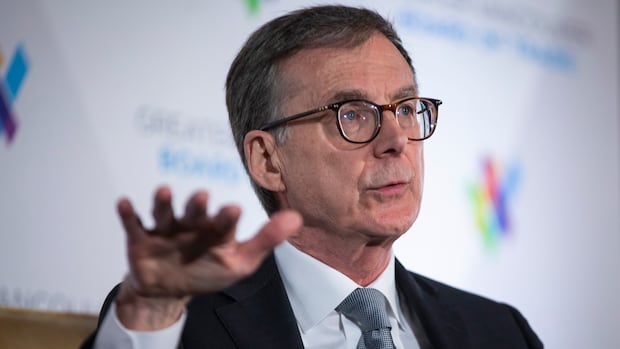
Bank of Canada governor Tiff Macklem will conclude his tenure at the helm of Canada’s central bank upon the expiration of his term on June 2, 2027.
In a statement released on Monday, the Bank of Canada announced that Macklem will not pursue a second term as governor after completing his current seven-year mandate. The central bank has initiated a search for his successor and aims to finalize this process by spring.
“During my time as governor, Canada has navigated a world that is increasingly fragmented and prone to shocks,” Macklem, aged 65, remarked on Monday.
“The Bank has responded to these challenges with decisive actions, exercising sound judgment amid uncertainty, and serving Canadians with humility and unwavering dedication to its mandate.”
Macklem’s retirement has been anticipated, as the last individual to serve a second term as Bank of Canada governor did so in 1980.
On Monday, the Bank of Canada revealed that the 12 independent directors on its board have established a search committee to identify the next governor. The recruiting firm Egon Zehnder, based in Zurich, will assist in the process, according to the statement.
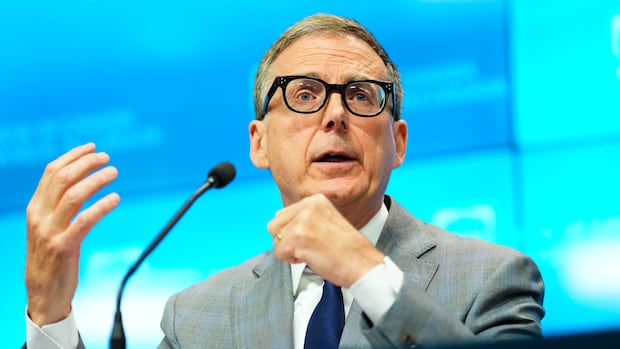
Bank of Canada governor Tiff Macklem, who held rates in October, says the bank needs to see ‘clear evidence’ that core inflation is moving down.
Although the board will technically select the new governor, the ultimate decision will lie with Prime Minister Mark Carney, a former governor himself, and Finance Minister François-Philippe Champagne.
A 14-page document outlining the role specifies that candidates must be Canadian citizens, possess a PhD or equivalent graduate-level degree in economics, fluently speak both official languages, and have experience at the highest levels of central banking, public policy, financial regulation, financial markets, academia, and/or international institutions.
Unprecedented challenges
Macklem’s governorship at the Bank of Canada commenced on June 3, 2020, coinciding with the onset of the COVID-19 pandemic’s first wave in Canada.
Before this, he served as the dean of the Rotman School of Management at the University of Toronto. He also held the position of senior deputy governor at the Bank of Canada under the previous governor, Mark Carney.
Throughout his leadership of the Bank of Canada, Macklem encountered extraordinary challenges, such as the inflation shock linked to COVID-19 and the ongoing trade conflict between Canada and the U.S.
After Canadian inflation peaked at 8.1 percent in mid-2022, Macklem spearheaded one of the most aggressive rate tightening cycles in the history of the central bank, increasing the policy rate from 0.25 percent to five percent. This involved implementing 10 consecutive rate hikes over a span of 16 months.
On Monday, Statistics Canada revealed that the annualized consumer price index for October was 3.1 percent. The Bank of Canada aims to maintain inflation at two percent, the midpoint of its target range.
While Macklem appears to have gained better control over soaring inflation, he arguably misjudged the trend in 2021. At that time, he and peers, including then-U.S. Federal Reserve chair Jerome Powell, characterized the rising prices as “transitory,” attributing them to temporary pandemic-related disruptions that would quickly resolve as the economy reopened.
“In hindsight, we could have likely started to withdraw stimulus earlier,” Macklem noted in a February 2024 address to the Montreal Council on Foreign Relations.
“Achieving the right monetary policy is challenging, and we won’t always get it right at every moment.”
Macklem’s time in office will also be marked by his straightforward communication regarding the repercussions of deteriorating Canada-U.S. trade relations.
For instance, during a speech in February 2025, he cautioned that substantial and enduring U.S. tariffs on Canadian imports would signify a “structural change” capable of inducing a “significant supply shock and a decrease in demand.”
This scenario would “resemble what occurred at the pandemic’s outset,” he conveyed to members of the Mississauga Board of Trade and the Oakville Chamber of Commerce. “However, while Canada’s economy returned to normal after the pandemic crisis subsided, this time there will be no recovery.”