
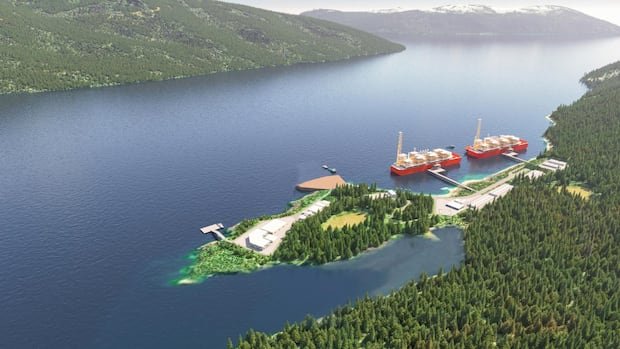
The announcement made on Wednesday revealed that the Ksi Lisims LNG project has secured a deal to supply liquefied natural gas to a German utility. This deal is projected to increase British Columbia’s annual greenhouse gas emissions by approximately six to eight percent, as calculated by CBC News.
According to a report by Environment and Climate Change Canada in 2024, the project’s estimates include emissions from gas extraction, transportation to the facility, construction, and facility operation. The report outlines two scenarios: one where the facility is connected to the B.C. Hydro grid, resulting in lower emissions, and another scenario where the facility is powered by gas-generated electricity.
Under the grid-connected scenario, annual emissions from construction would be around 58,877 tonnes of carbon dioxide equivalent, with total emissions from extraction, transport, and operation just under 3.5 million tonnes per year. If gas is used for electricity generation, construction emissions would rise to 212,109 tonnes annually, with total emissions from extraction, transport, and operation exceeding 5.1 million tonnes each year.
In 2023, British Columbia’s total greenhouse gas emissions were reported at 61.1 million tonnes of carbon dioxide equivalent. The Ksi Lisims LNG project, co-owned by Western LNG, Rockies LNG Partners, and the Nisga’a Nation, signed a memorandum of understanding earlier this year with B.C. Hydro for electricity supply to the proposed floating LNG facility.
The B.C. government stated that once Ksi Lisims is connected to the grid, it aims to achieve net-zero emissions, partly through the use of carbon offsets. However, the environmental assessment conducted by the government only included emissions related to the construction and operation of the facility, omitting emissions from gas extraction and transportation.
Proponents of the project argue that despite potential increases in B.C.’s and Canada’s greenhouse gas emissions, the project would be beneficial globally by replacing dirtier energy sources like coal with lower-emission LNG. However, uncertainties remain regarding factors such as cost competitiveness, the fuel sources LNG would replace, and the pace of international transitions towards net-zero emissions.
The deal with Germany’s Securing Energy For Europe (SEFE) entails the purchase of a million tonnes of LNG annually from Ksi Lisims for up to 20 years, with the project having a planned capacity of 12 million tonnes per year pending a final investment decision.